ISA vs Roth IRA - Are They the Same?
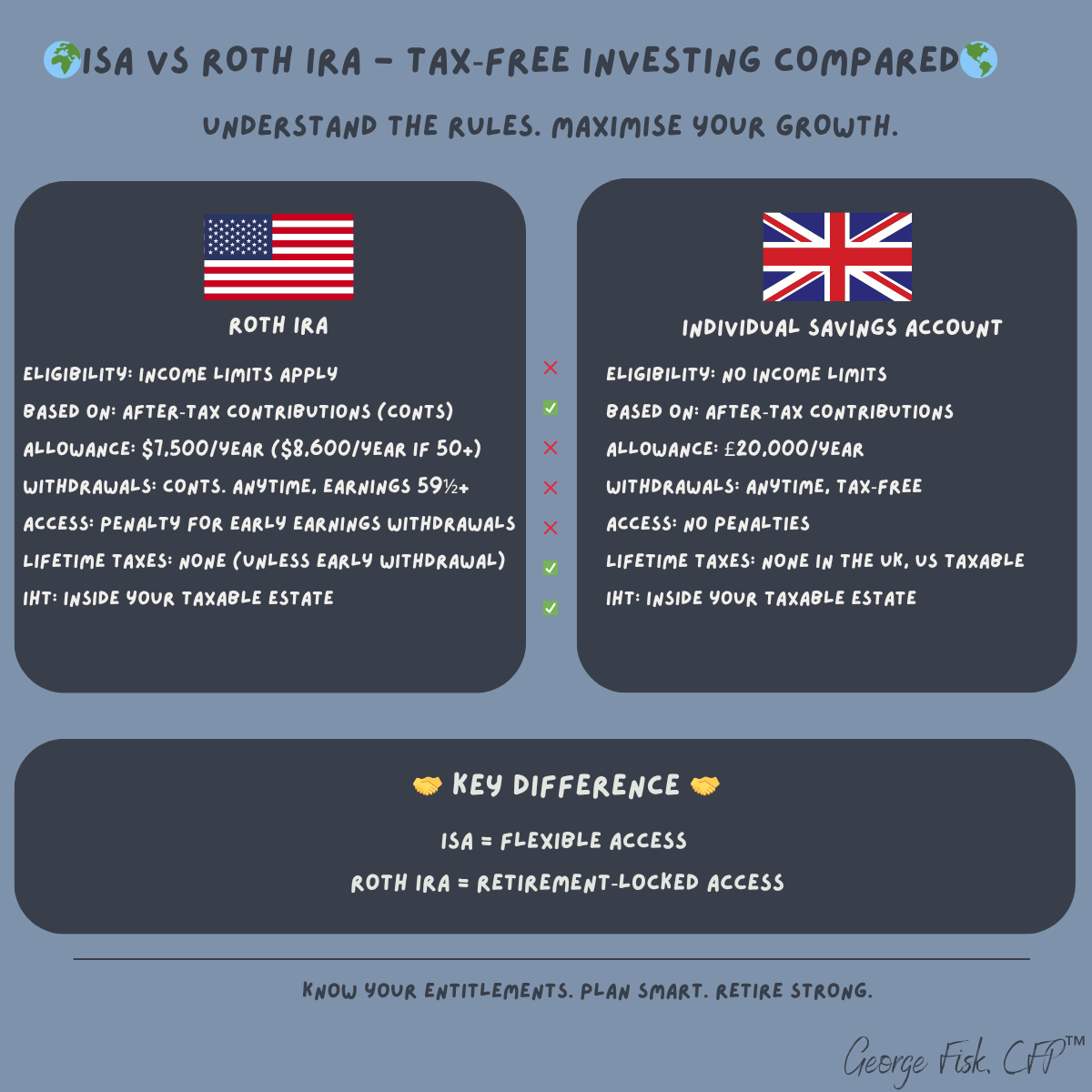
ISA vs Roth IRA: What US Expats in the UK Need to Know
Why a simple comparison can be misleading for cross-border planning
If you’re moving between the US and the UK, it’s natural to compare familiar investment accounts.
A common question is:
“Is a UK ISA the same as a Roth IRA?”
On the surface, they look similar. Both are designed to provide tax-efficient investment growth.
But for US citizens living in the UK, the reality is more complicated.
Understanding the differences, and how each is treated across both tax systems, is essential to avoid unexpected tax and planning issues.
What is a Roth IRA?
A Roth IRA is a US retirement account funded with after-tax contributions.
Key features include:
Investments grow tax-free for US purposes
Withdrawals are tax-free in retirement (subject to rules)
Contributions are made from earned income
Annual contribution limits apply
For US residents, this is one of the most tax-efficient long-term investment structures available.
What is a UK ISA?
An Individual Savings Account (ISA) is a UK tax wrapper.
Key features include:
Investments grow free from UK income and capital gains tax
Withdrawals are tax-free in the UK
Annual contribution allowances apply
Flexible access (depending on ISA type)
For UK residents, ISAs are a core part of tax-efficient investing.
The key issue: they are not equivalent across borders
While both accounts are tax-efficient in their home country, they are not treated equally in a cross-border context.
This is where problems arise for US expats living in the UK.
How Roth IRAs are treated in the UK
In many cases, Roth IRAs can retain favourable tax treatment in the UK, particularly where treaty provisions apply.
However, this is not always straightforward.
Considerations include:
whether contributions were made while UK resident
how the UK interprets the account under tax rules
the timing of withdrawals
Used correctly, a Roth IRA can remain a valuable part of a long-term plan, but it needs to be coordinated with UK tax rules.
How ISAs are treated for US citizens
This is where many expats are caught out.
While ISAs are tax-free in the UK:
They are not recognised as tax-efficient by the US.
This can mean:
income and gains inside the ISA may still be taxable in the US
additional reporting requirements
potential exposure to complex US fund rules
In some cases, holding certain investments within an ISA can create further complications.
Investment complications inside ISAs
For US citizens, investing within an ISA can trigger issues such as:
holding non-US funds that fall under US anti-deferral rules
complex tax reporting requirements
potentially unfavourable tax treatment
This means that while an ISA may look attractive from a UK perspective, it can be problematic when viewed through a US lens.
Which is better: ISA or Roth IRA?
There is no one-size-fits-all answer.
It depends on:
your tax residency
where your income is earned
your long-term plans (US vs UK retirement)
your existing accounts and assets
In general:
Roth IRAs can be highly effective if managed correctly within a cross-border plan
ISAs require more caution for US citizens, particularly in terms of investment selection and reporting
A joined-up approach is essential
The key takeaway is that these accounts should not be viewed in isolation.
Decisions about ISAs and Roth IRAs need to be made as part of a coordinated US–UK financial plan.
This includes:
understanding how each account is taxed in both countries
selecting appropriate underlying investments
aligning your strategy with long-term residency and retirement goals
